Creative Biolabs is offering the most comprehensive services for antibody development projects. With strict regulation and effective execution, we are dedicated to providing the most valuable solutions to complete your projects.
HighlightsCreative Biolabs is offering the most comprehensive services for antibody development projects. With strict regulation and effective execution, we are dedicated to providing the most valuable solutions to complete your projects.
HighlightsCreative Biolabs has established a broad range of platforms for developing novel antibodies or equivalents. These cutting-edge technologies enable our scientists to meet your demands from different aspects and tailor the most appropriate solution that contributes to the success of your projects.
HighlightsWith deep understanding in antibody-related realms and extensive project experience, Creative Biolabs offers a variety of references to help you learn more about our capacities and achievements, including infographic, flyer, case study, peer-reviewed publications, and all kinds of knowledge that can assist your projects. You are also welcome to contact us directly for more specific solutions.
HighlightsGet a real taste of Creative Biolabs, one of the most professional custom service providers in the world. We are committed to providing highly customized comprehensive solutions with the best quality to advance your projects.
HighlightsRepresenting over 60% of modern drug targets, membrane proteins are central to therapeutic innovation. However, their inherent instability and complex native environment make them notoriously challenging subjects for analysis. Creative Biolabs, with over two decades of pioneering experience in biotechnology, offers a comprehensive suite of Membrane Protein Affinity Measurement Services, leveraging state-of-the-art platforms to deliver unparalleled precision, sensitivity, and throughput. Our platform provides robust, in-depth characterization of molecular interactions, empowering researchers to decipher binding kinetics, stoichiometry, and thermodynamics. By overcoming the traditional hurdles of membrane protein analysis, we accelerate your research and drug discovery pipelines, ensuring that you can make data-driven decisions with the utmost confidence.
Membrane proteins, including G-protein coupled receptors (GPCRs), ion channels, and transporters, are embedded within the lipid bilayer, a unique environment that is essential for their correct folding and function. Isolating these proteins for in vitro analysis without disrupting their native conformation is a significant technical challenge. Traditional binding assays often fall short, compromised by issues such as:
Accurate affinity measurement is non-negotiable for success in drug discovery. It is fundamental to:
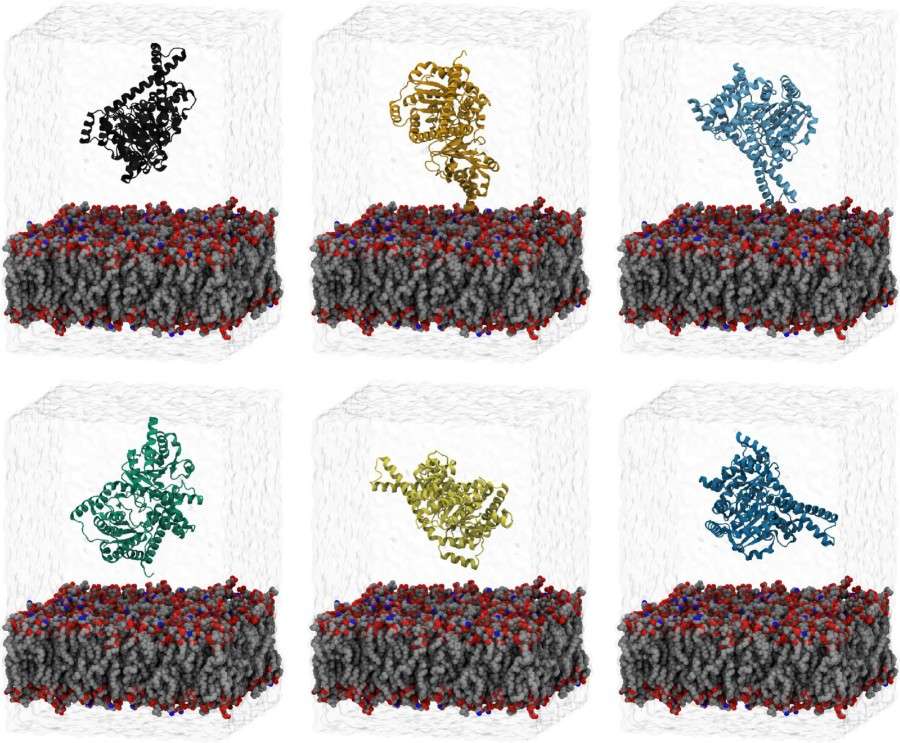 Fig. 1 Molecular dynamics simulation setups to test membrane association (side view).1
Creative Biolabs has curated a portfolio of cutting-edge, label-free technologies to provide a multi-faceted approach to membrane protein affinity measurement. We recognize that no single technique is universally applicable; therefore, our experts work closely with you to select the optimal platform based on your specific protein, ligand, and research goals.
SPR is a premier optical technique for monitoring molecular interactions in real-time. It measures changes in the refractive index at the surface of a sensor chip as an analyte flows over an immobilized ligand. This allows for the precise determination of association (k_a) and dissociation (k_d) rates, from which the equilibrium dissociation constant (K_D) is calculated.
At Creative Biolabs, we have developed proprietary methods to immobilize membrane proteins, ensuring maximal activity and correct orientation, making SPR a powerful tool for everything from fragment screening to antibody characterization
BLI is an optical biosensing technology that measures the interference pattern of white light reflected from a biosensor tip. As molecules bind to the tip, the thickness of the biological layer increases, causing a wavelength shift that is directly proportional to the amount of bound mass.
BLI is an excellent choice for primary screening, epitope binning, and rapid quantification of binding affinity, providing a significant advantage in early-stage discovery programs.
MST is a powerful biophysical technique that measures the motion of molecules along a microscopic temperature gradient. This movement, known as thermophoresis, is highly sensitive to changes in a molecule's size, charge, and hydration shell. When a ligand binds to a target protein, these properties are altered, leading to a detectable change in its thermophoretic movement.
MST is particularly valuable for studying challenging targets like GPCRs and for interactions that are difficult to measure using surface-based techniques.
ITC directly measures the heat released or absorbed during a binding event. It is the only technique that can determine all binding parameters—affinity (KD), stoichiometry (n), enthalpy (ΔH), and entropy (ΔS)—in a single experiment. This provides a complete thermodynamic signature of the interaction.
By titrating a ligand into a sample cell containing the membrane protein, ITC measures the minute temperature changes that occur upon binding.
Understanding the thermodynamic drivers of an interaction is crucial for rational drug design and lead optimization. ITC is a label-free, in-solution technique that provides unambiguous binding data without the need for modifications or immobilization.
| Technology | Principle | Throughput | Sample Consumption | Key Output | Best For |
| SPR | Refractive Index Change | Medium-High | Medium | Full Kinetics (ka, kd, KD) | Detailed kinetic analysis, SAR studies |
| BLI | Optical Interference | High | Low | Kinetics (ka, kd, KD) | High-throughput screening, epitope binning |
| MST | Thermophoresis | Medium | Very Low | Affinity (KD) | Immobilization-free analysis, complex samples |
| ITC | Heat Change | Low | High | Full Thermodynamics (KD, ΔH, ΔS, n) | Mechanism of Action, thermodynamic profiling |
Choosing Creative Biolabs means partnering with a leader in membrane protein services. Our commitment to scientific excellence is reflected in:
To further support your research, Creative Biolabs offers a suite of Affinity Measurement related services:
Q: What is the minimum amount of protein required for an affinity measurement study?
A: The amount of protein required varies significantly depending on the technology used. MicroScale Thermophoresis (MST) is the most conservative, often requiring only a few micrograms. SPR and BLI typically require tens to hundreds of micrograms, while ITC is the most material-intensive, potentially needing milligrams of protein for a full thermodynamic analysis. Our scientists will help determine the best approach based on your protein availability.
Q: Can you measure the affinity of very weak interactions?
A: Yes. We can design experiments specifically for detecting and quantifying low-affinity or transient interactions, which are common in biological signaling and fragment-based screening. Techniques like SPR are highly sensitive and can be optimized to capture these interactions, while MST is also well-suited for a wide range of affinities.
Q: My membrane protein is very unstable. Can you still work with it?
A: Absolutely. Our expertise lies in handling challenging proteins. We offer comprehensive membrane protein solubilization and stabilization services, utilizing a wide range of detergents, lipids, amphipols, and nanodiscs to maintain the protein's structural and functional integrity throughout the experiment.
Q: Do I need to provide a purified protein?
A: While purified protein is ideal for most techniques, it is not always necessary. Technologies like Bio-Layer Interferometry (BLI) and MicroScale Thermophoresis (MST) have a high tolerance for crude samples, allowing for measurements in complex mixtures like cell lysates or membrane preparations, which can save time and preserve the protein in a more native state.
All listed services and products are For Research Use Only. Do Not use in any diagnostic or therapeutic applications.